
Transgender Rights Summit: Key Demands and Critical Gaps
Legal Aid Society
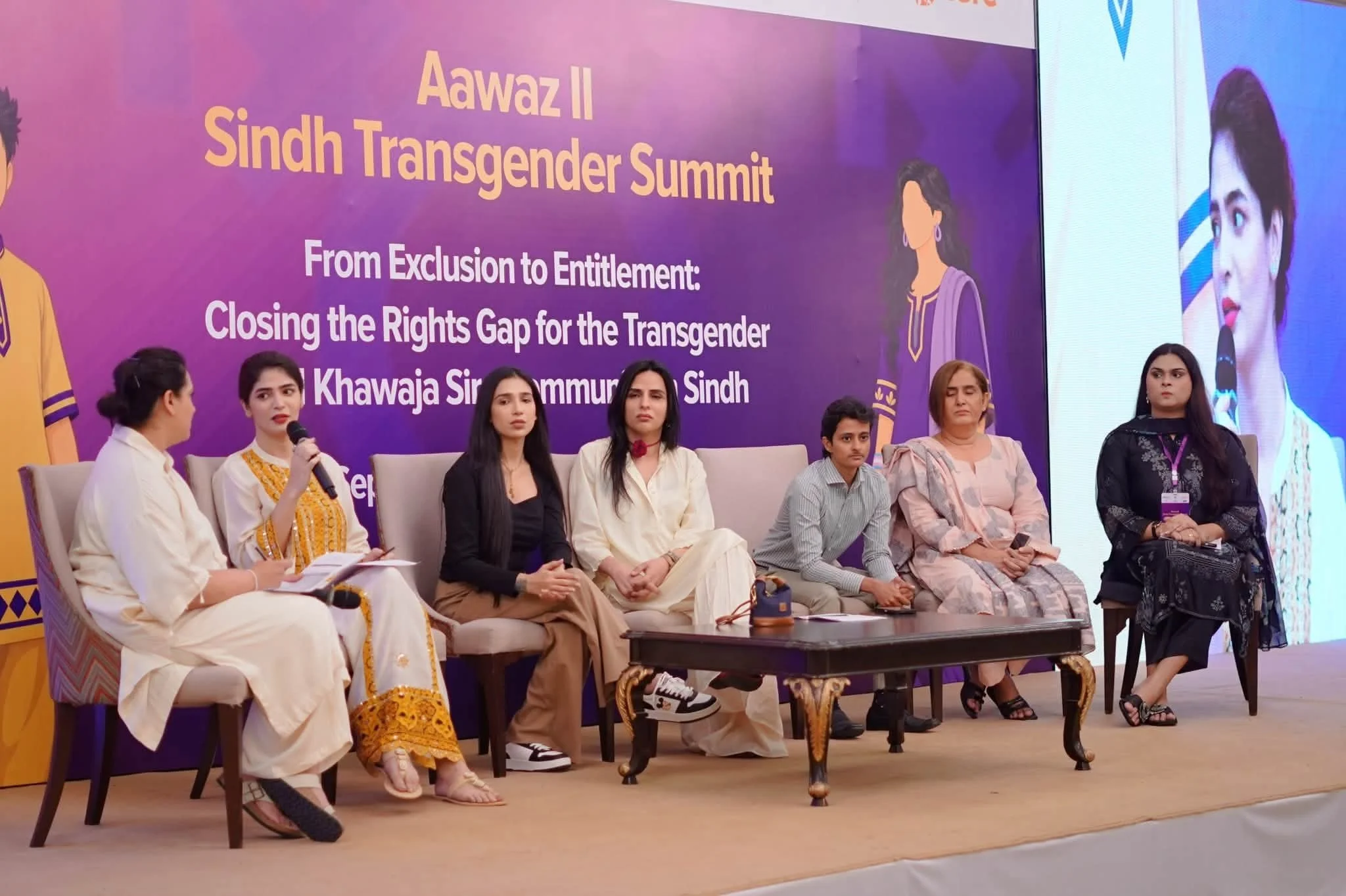
Few days ago, I had the opportunity to attend a summit on transgender rights organized by the Legal Aid Society. The seminar highlighted the challenges and issues faced by transgender persons in Sindh province. It was attended by various government agencies, NGOs, and INGOs working on transgender rights.
The leading figures of the transgender community shared the grievances and sorrows of individuals who are deprived of their basic rights. They presented a charter of demands to government representatives. Their demands include: Establishment of emergency safe houses, Implementation of Sindh’s Transgender Education Policy, Enforcement of the 0.5% government employment quota, Dedicated healthcare wards, Social Protection/ BISP benefits, Mandatory police sensitization, Identity and CNIC access with formal legal recognition of the Guru system.
These are the basic rights of every individual in society. Most of us are aware that transgender persons are among the most vulnerable and deprived community in Pakistan. They need extra attention, but unfortunately, the state has failed to provide them with their fundamental rights. Although laws exist to protect them, the real question is: Who ensures the execution of these laws? Who implements them? And after implementation, do transgender persons truly receive dignity?
Are these laws enough to change the mindset of common people? In a society where even their own families are often unwilling to accept them, how can we expect society at large to embrace them with dignity?
We must revisit our education system. What lessons do we teach our children regarding transgender persons? Unfortunately, our basic education curriculum lacks subjects on ethics and civic sense. Without these, we cannot cultivate respect or ensure rights for marginalized communities. I also observed that no transgender‑led roles were discussed from this very important perspective. Likewise, vocational training for the transgender community was not addressed. Through vocational training, we can help transgender persons overcome many negative aspects associated with their socially deprived status.
During the panel discussion, it was evident that the panelists were not focusing on the real grievances of the majority of transgender persons who live in miserable conditions. Everyone seemed more interested in solutions that served their own needs and desires. Are a few job opportunities enough to address the issues of the entire community? According to Pakistan Census data (2023), the identified transgender population is 20,331, NADRA has issued over 28,000 CNICs with gender marked as X (Transgender). UNDP and Khawaja Sira Society estimate the population to be around 300,000.
If the community leaders truly wants to change the lives of transgender persons, they must propose concrete, multi‑factor, and multi‑dimensional solutions. Photoshoots and drawing‑room discussions with high‑level bureaucracy may look impressive, but they do not solve the problems of common transgender individuals. One speaker said that transgender persons not only have beautiful faces but also beautiful hearts. This is true — and they deserve the best.