There Is No Villain: Fight or Flight at the MATCH
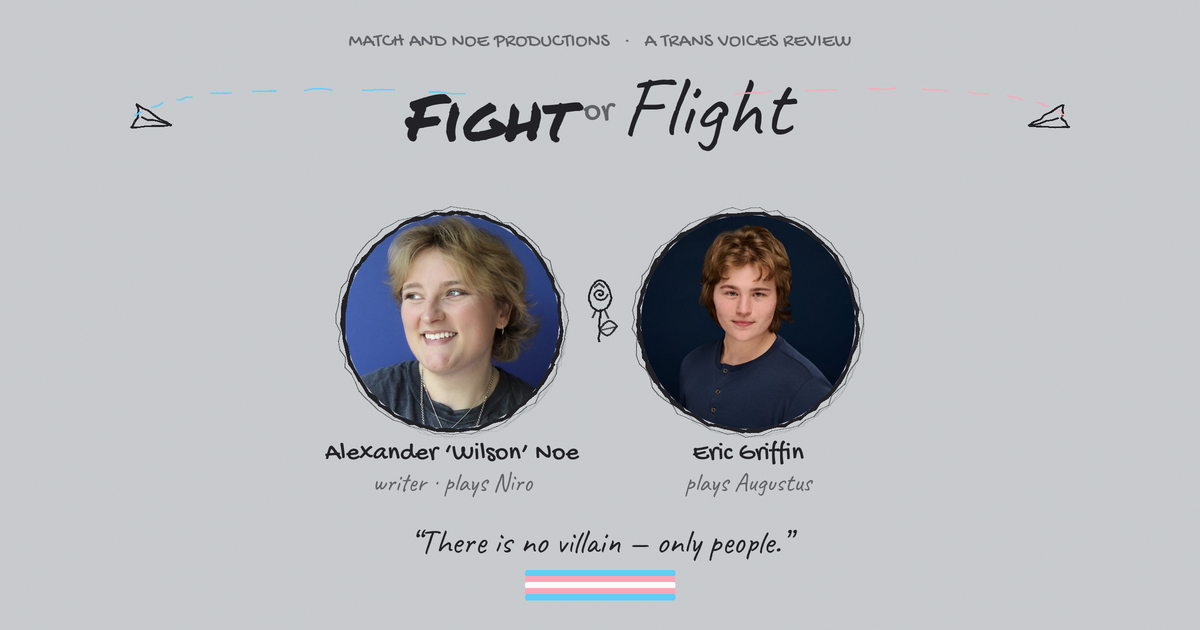
Alexander Noe, Eric Griffin
Trans Voices spent all of Sunday, July 19, with Fight or Flight: the morning interviewing playwright Alexander "Wilson" Noe and actor Eric Griffin, the evening watching the world premiere in Matchbox 2, and the night at El Tiempo's, still discussing it hours later.
Noe wrote the script and is still rewriting it. He built the play by reaching out to domestic-violence shelters and to trans people who'd been outed, and it shows: none of the fights feel invented.
The structure is a courtroom. Fight or Flight is nonlinear, and the relationship between Niro Claudius (Noe) and Augustus Cessar (Griffin) unspools in flashbacks, each one triggered like a piece of evidence, so you're seated as a jury from the first minute. You watch the couple slide from the giddiness of their wedding vows into ad hominem insults and escalating cruelty. But watching isn't all the play asks of you.
Two cards wait under every seat. At the close, the audience votes: red if Niro is the villain, blue if Augustus. The playbill promises the choice "will mean life or death," and I'll leave it there; the production keeps the real weight of your vote hidden until it's already out of your hands. We come in as an audience and end up a jury, and none of us understands, raising a card, how much the verdict is about to cost.
The performances
Izzy Sharp's Narrator is the most alive thing on the stage. She's everywhere at once, tumbling across it, physical to the point of recklessness, reacting to fights she has no part in and mirroring the couple's inner dialogue. When an audience member asked at the talkback whether she was meant to be the inner child, Griffin confirmed it, and the answer reorganizes the whole performance: she's the unguarded, wounded self living inside both men. The actress showed us the bruises afterward.
That Griffin and Noe are 19 and 22 is hard to believe. Their performances carry a rawness I'd expect from actors twice their age. More than once I watched an emotion cross a face before the line caught up to it, and more than once it brought me to tears.
Noe told us the shape of the play is the part that undoes him every night: the couple's first words are their wedding vows, and their last are the cruelest things they say to each other. Watching that distance open in real time leaves the cast in tears onstage, and it did the same to us.
"It's my story to tell"
One scene I can't shake is when Niro reveals that he's told his parents Augustus is trans. Augustus is furious, not because the parents are unsafe (Niro insists they're wholly supportive) but because the disclosure was never Niro's to make. "It's my story to tell," he says. Griffin named it his favorite line, and I understand why; it's the sharpest in the play.
I found myself siding with Augustus. Being outed against your will is a violation even when nothing bad follows, because disclosure is one of the few things that belongs entirely to us. Niro's defense, that these are his parents and therefore his right, comes from a loving place and still lands as a betrayal. When he adds that Augustus's family "doesn't love him," the last of my sympathy for him goes.
Then the play refuses to let that verdict settle. Late in it, a conflict that has been verbal all night - cruel, but contained - stops being either, and the certainty I'd built up drained out.
I raised my card less sure than I'd been ten minutes earlier. I won't say which card I raised.
No villains, only people
At the talkback, Noe said he doesn't believe villains exist, only people, and the play earns the claim. Neither man is innocent and neither is a monster. The vote asks you to reduce two whole people to a single verdict and then to carry it out of the theater with you.
There's a quieter choice I want to point out for other trans writers: that Niro and Augustus are trans is incidental to the story, not its subject. We need work that makes trans identity its theme, and Trans Voices exists partly because we do. But we also need work that lets trans characters be difficult, jealous, petty, in love, and wrong. Fight or Flight is a play about class, family, resentment, and the slow accumulation of small harms between two people who once adored each other, and its leads happen to be trans the way anyone happens to be anything. Noe puts it plainly: "It's not a trans play. It is a domestic violence show." He's watched audience after audience recognize their own relationships in it. Staging trans lives without ceremony is its own kind of representation.
Go see it, then argue about your vote
I want to see Fight or Flight again. There are endings I haven't seen, and the cast has a favorite; the version headed to the Edinburgh Fringe this August also swaps the child narrator for a maternal inner voice, which should change the temperature of the whole piece. The production keeps rearranging its own frame, and yet, night after night, audiences have landed on the same card with unsettling consistency. A show built so that no two performances end alike isn't finally asking who's right. It's asking what we're willing to forgive.
That's a harder question than most theatre is willing to sit with, and it's why Fight or Flight hasn't left me.
The full interview with Noe and Griffin goes up on the Trans Voices Podcast the week of this posting. Follow the show on Spotify to be notified the moment it's live, and you can support the production at linktr.ee/fightorflighttheplay.
Trans Voices Houston thanks MATCH and Noe Productions for the invitation to the premiere.